Traceability
Your traceability matrix, alive.
Somewhere right now, an engineer is updating an Excel sheet that maps requirements to implementation — and hoping nothing moved since last week. Pragma does traceability the way it should work: as the structure of the plan itself.
Try it — click an item, then break the schedule
"Integrate PSP SDK" exists because of "3-D Secure payments", which answers "Checkout v2 live".
Traceability by construction
Links aren't decoration — they're typed. A task answers a requirement; a requirement answers a deliverable. The chain from any piece of work up to the thing you promised is always one query away, in both directions.
Gaps found before the audit does
Orphan detection flags work that answers nothing and requirements no work answers. A requirement can't be closed while open work still answers it. Cycles and unschedulable plans are caught by the built-in structure check.
Change with your eyes open
Before you descope or delay, impact analysis shows everything downstream. Every status move is recorded in an append-only history — who, when, and which connected app — exportable as CSV or JSON.
The living matrix
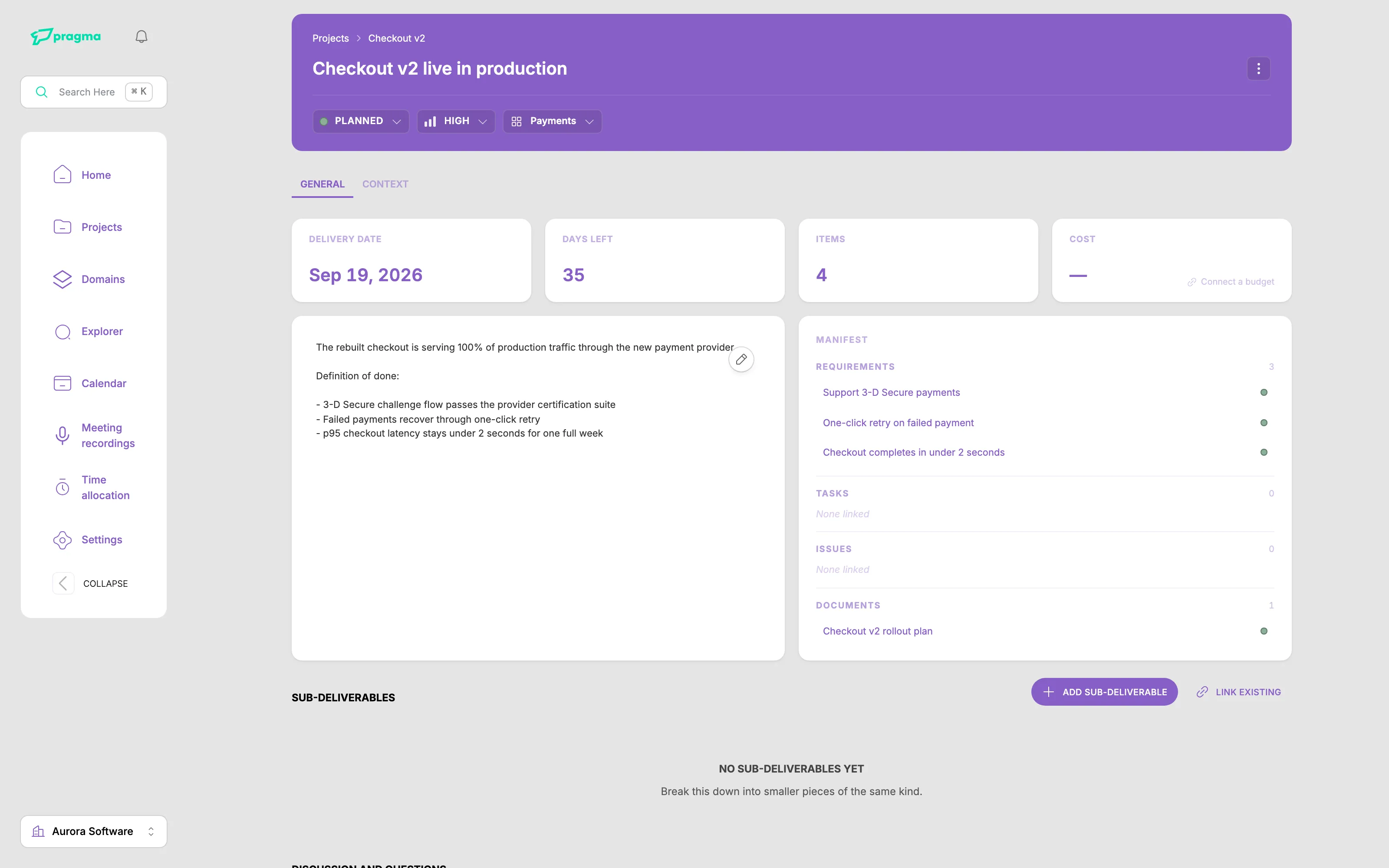
Every deliverable carries its own manifest.
Open a deliverable and the traceability matrix is already there: the requirements that answer it, the state of each one, the documents that govern it. No export step, no reconciliation meeting — the matrix is the plan, so it can't drift from it.
Where Pragma fits
If your programme is audited against DO-178C with a validated toolchain, the enterprise ALM vendors earn their price — that is exactly what they are built for. Pragma is for the far larger group of teams who need traceability-grade rigor — the live chain, the gap detection, the audit history — inside a fast, modern tool the whole team actually uses, at a price that doesn't require a procurement committee: flat €29/month for a whole organization.
Retire the spreadsheet.
Import your requirements, link the work, and the matrix maintains itself.
Start free